Englischer Originaltext
Für diese Aufnahme gibt es noch keine vollständige deutsche Übersetzung. Hier können Sie das englische Originaltranskript lesen und herunterladen.
Vollständiges Transkript
Aufgenommen am 25. April 2025 · 9 Std. 49 Min.
← Diese Aufnahme anhörenFür diese Aufnahme gibt es noch keine vollständige deutsche Übersetzung. Hier können Sie das englische Originaltranskript lesen und herunterladen.
Beim Hören mitlesen
Hello and welcome to Jason Newland.com. That's my website. My name is Jason Newland. Please only listen when you can safely close your eyes and welcome to Let Me Bore Your Pain Away.
Now, this is specifically to help people with chronic pain. So you need to know the cause of the chronic pain and also have permission from your doctor before listening to this. This is not a replacement for any kind of medical attention, medical advice, or any kind of therapy.
Therapy. Right. That being said, it's just me chatting.
It's what I do. I just talk. These Let Me Bore Your Pain Away recordings are very similar to the Let Me Bore You To Sleep.
I just chat. Sometimes I go off the subject. Sometimes I come back to the subject.
Sometimes I focus occasionally. But the main objective is that how you feel now changes and you feel better at the end of it. You feel more relaxed.
And, you know, if you were to gauge the level of discomfort, physical discomfort from zero to 10, it may be higher than 10, maybe lower than zero. If it's lower than zero, you don't really need to be listening to this unless you just want to listen to relax more. But just gauge where it is now, that physical feeling.
And then at the end of it, we can do it again. You can just like see how you feel. And really the bottom line is, is it useful? If it's useful, good.
And just let you know, I've got a little Jack Russell in the background chasing a fly. So you're going to hear a little bit of scuffling about because it's amazing. If only I knew all the toys he's got, all the different things he's had, I nearly said the word T-R-E-E-E-E-T-S.
Luckily I didn't because he'd been staring at me right now. All I need to do is just get him a fly. He'd have been happy.
So yeah, he's just chasing it. So this isn't sleep. It's not a sleep recording.
You may just find yourself getting bored and go to sleep just out of complete boredom, but that's possible. But it's not, it's not a sleep recording. It's just, it's relaxing, hopefully gentle, calming.
And you can listen to my squeaky voice and let your, it's not even about letting your mind slow down or letting your body relax. It's kind of your body just does that anyway. And your mind generally just slows down when listening to me because even though I personally think I've got a super exciting voice, not everyone agrees.
I think I'd be quite good at commentating on a racing, you know, like a, like that horse racing and stuff. You know, I think I'd be quite good. Yeah, Chepstow's running and Horsey Deparkey's next to it running and Tony is a little bit ahead and one of them's going to win probably.
Yeah, one of them's won. How is that not exciting? So I try and have a particular idea to wrap your mind around in these recordings. And sometimes it's just vague and I just wrap it on about my toenails or something exciting like that, something relevant.
But today I'm going to talk about pain being a protector, not a damage meter. Okay, so that's what I'm going to talk about. And I had the inspiration, I was listening to a book earlier.
And it reminded me of something that I've talked about before in probably one of my older recordings, maybe one of my most recent recordings because I don't know, I don't really listen back to most of them, but I may have the tendency to repeat myself. I don't listen to, you know, all my recordings, but I think sometimes I do have the tendency to, so I won't, I'm just being silly. So the core message of this recording is chronic pain is a protector, it's not a damage meter.
So pain itself is there to protect you. It's there to let you know that you need to do something, basically. And I'm talking from a lay person's perspective, I'm not an expert on anything.
I think picking my nose is probably the only thing that I'm actually an expert at, but apparently, you can't get a degree in that. It's not fair. I used to be quite good at cutting my toenails.
Don't get me started on toenails, it's my favourite subject. But I just can't reach anymore. I just have to drop some dog food on my feet and hope that Vinny chews the nails off.
That's weird. What a weird visual. Okay, let's move on from that.
That didn't happen. And so, also let you know, I do have a Facebook group called Jason Newland's Boring Group. It was 217 members, now it's 216.
Someone's left. Where you gone? And we have got a YouTube channel, which is at Jason Newland, which is also my podcast. So upload all my latest recordings on there.
Now, since I've been uploading all the podcast episodes, I'm getting less, less views, because I guess it's just so many. So I guess I do six versions of each recording. And sometimes I do two recordings, sometimes even three a day.
You know, at least one a day normally. Although there are times when I don't do anything for a while, it depends on how I'm feeling. So I do six different versions, one without music, one with music, five and 10 hours, both with and without music.
Just gives you a choice, a choice. I tried to stop doing so many a while back. But every time I cut back, someone said, Oh, I prefer the ones, prefer the one, the five hour ones with music or further 10 hour ones without music, or the ones without music, the you know, just like different people like different things.
So hopefully, I'll try to cover as many bases as possible. Also do have a Q&A Friday that I do every Friday, which is basically I answer any questions that you have. You can go to my website, Jason Newland.com. And there's actually a form you can fill in on there.
It's just a question, anything you want me to talk about anything at all. If it's something I can't answer, then I just won't answer it. But, you know, I do try and cater to questions.
Now I'm wondering who's left the group. It might be someone who's just come off of Facebook. That happens sometimes.
Yeah. Honestly, there's people, there's someone joined, invited 17 hours ago, I've not invited anybody. But they're not in there, they can view the group, but they're not actually a member of the group.
So, oh, well, right. Here's my premise for this recording. When the brain believes the threat is gone, or at least safely controlled or contained.
It just turns the alarm down. That alarm, that, that like beep, beep, beep, beep, beep, beep, beep. I don't know why I did the sound of an alarm, because you probably know what the sound of an alarm is.
I mean, they can have lots of different sounds, can't they? I suppose if I was to have an alarm after me, it'd be, I don't know, a bit, not a very enthusiastic alarm. Oh, someone's broken into the car. Oh.
So, Vinny's flapping his ears. He likes to be known. He likes to be everyone who's listening to a recording.
I think he likes to be part of the recording. Sometimes he whines. Sometimes he hassles me.
Sometimes he jumps around trying to get to a fly, which is what he's doing now. Although it looks like he's trying to get out the front door or out of the living room door for some reason. But he's very focused on the fly still.
So you'll hear that. Anyway, I would need to get on already. Nearly the end of the recording already and I haven't actually spoken about anything.
So it's basically a very basic single idea about when the threat isn't there, when you know that there's no threat, which is something you have with chronic pain. You know there's no threat. Acute pain is a different thing.
It's letting you know there's something and it's happening now and it's something you need to deal with. Chronic pain is something that's, it's a part of your body that's healed. Or as far as damage, you know, if you had an injury and something like arthritis, it's chronic pain, but it's kind of somewhere in the middle really in a sense of maybe you need to be careful, that part of the body.
But at the same time, what use is that physical distress? What use is it to you? If you're careful, you know, like it kind of comes to a point. So someone, if you've got, I've got arthritis in my lower back and I think the whole world's going to know about this at the end of these recordings because I keep talking about it. But that's it, Vinny, make a little bit more noise.
Thanks, mate. When you know the cause and when you know you're actually OK, and it's just one of those things. Can't necessarily be changed, but you can do exercise.
I do exercise for my lower back. You may be able to make changes with diet. For example, I lost some weight because the weight was putting pressure on my back.
That helped. There's some practical things that your doctor or your therapist can tell you about that I can't tell you about. I can't give advice on anything like that.
I don't give advice on anything. Isn't it weird? I just had the urge. I had this screech outside and I just had the urge for ice cream.
Strange how the brain works, isn't it? So I'm going to start off focusing on a broken bone, for example. Vinny, calm down, mate. Catch it.
If only he could fly. I think he's the only dog in the world that wishes he could fly. I think he might wish he was a fly.
He's got such advantage over him. But I don't want it in the living room, though. I don't mind if it's in the kitchen.
I don't leave food out or anything. I'd rather it not be in the flat at all. I don't want it in the bedroom.
But I don't think he likes going to the bedroom because it smells too bad. That's wrong. I shouldn't say stuff like that.
It's very lovely in the bedroom. But you know, you've got me in a... Anyway, he doesn't seem to want to go in the bedroom for some reason. Sometimes it follows me into the bathroom and depending on what I'm doing, sometimes it just leaves really quickly.
I remember I closed the door and I was on the toilet and I could literally see the fly smashing against the window trying to get out. And I thought, why is he making so much noise? And I realised he had this little hammer and he was trying to smash through the window. Help.
Help. It stinks. Like, rude.
So in the living room, I don't like him being in there because this is, you know, if I've got a cup of tea, I've got a habit of just walking along the rim. Like, I don't want to fly on my rim. Nah, I don't want that.
So basically, I like to keep the rim clean. Because my mouth's going on it, isn't it? So I don't want a fly going where my mouth goes. And I'm pretty sure the fly doesn't want to go where my mouth's been either, which is rude again.
So the idea of a broken arm... You break a bone. So I broke my wrist a few years back. I fell out the bath.
Not supposed to be funny, but I suppose it is quite a funny scenario. And wow, it hurt. So I go to the doctors, I go to the hospital, sorry, and have to have an x-ray.
I'm in there for, to be fair, back then, because it was a few years back, about nine, nine years ago. I didn't have to wait as long as the Q's now. I mean, I fractured my back a couple of years ago, I was probably 12, 13 hours in the A&E.
But this time I was there for about six, six, seven hours. So I got seen fairly quickly. And it was, it was broken.
It's just simple as that. Yeah, it's broken. So okay.
So I went up to see a nurse or a specialist or whatever in the bone category, the bone department, the broken wrist department, I don't know, wherever it was. And they said, you've got two choices. I thought, brilliant.
I actually thought he was going to offer me some biscuits, but nothing like that. I thought it was going to be a buffet. Will you stop jumping around, Finny? And I said to, he said, well, you can have, it's broken.
I said, yeah, I know. Any biscuits? And he said, no. I said, I bet you have got some biscuits though, haven't you? He said, what do you mean? I said, well, you sit in there, be on a desk.
And you've got, I know you've got a cupboard, at least one cupboard behind there. And I know you've got a couple of drawers. It's a big desk, couple of big drawers.
You tell him there's no biscuits, no Kit Kats, no chocolate, nothing. He said, why are you asking that? I said, I don't know. I just, for some reason, well, I haven't eaten for ages because I've been, you know, been waiting to have my arm looked at.
He said, well, you do have vending machines, you know? I said, I know, but if I go to the vending machine, I'll lose my seat. He said, why don't you get the person that's with you to save the seat? I said, I don't have anyone with me. He said, oh, haven't you got any friends? I said, that's, well, you can't say that to me.
Have I not got any friends? Unless, of course, you're offering to be my friend. He said, no, I'm not. I said, well, it's rude then.
You shouldn't say, have you got any, haven't I got any friends? He said, I'm just asking. I said, why? He said, because now you know what it feels like. I said, Doc, what do you mean now I know what it feels like? Now you know what it feels like to be asked personal questions.
What are you talking about? Well, you asked me about my biscuit collection. You asked me about my chocolate, how many Kit Kats, how many packets of Jaffa cakes, and how many, I mean, even the Easter egg from three months ago that's not been opened yet, that I've been saving for that, you know, Friday afternoon when everything's a bit, when I've had just the most annoying customer come in. I think they're called patients, not customers.
Customers, patients, clients, annoying people, that's all they are. You can't talk, you're a doctor, you're not supposed to talk like that to patients. You nearly said customers.
I know, it's because you said it. That wasn't even a real laugh, was it? Yeah, it was a real laugh. Listen, Doc, by the way, why do you keep saying Doc? Oh, I know why you keep saying Doc.
Why? Go on, enlighten me, you know why? Yeah, the reason you keep saying Doc is so that people listening to this podcast know which person's speaking. Yeah, exactly, because you, instead of putting on different voices for each person, how, it's hard to follow. What is the same voice? It's like just one voice talking to the same exact voice.
Right now, some people might be wondering, who's talking now? Is it a doctor or is it you? I said, we talk about podcasts. He said, you're doing the Let Me Bore Your Pain Away. I said, no, I've not even started doing a Let Me Bore Your Pain Away.
I don't even know what Let Me Bore Your Pain Away is. He said, it's a branch off of Let Me Bore You To Sleep. I said, what do you mean Let Me Bore You To Sleep? What's that? He said, it's your podcast.
You've got like 1400 episodes. You've been doing it for eight years or seven, eight years. I haven't.
Oh, I know what you've done, doc. What? You've forgotten what year we're in. Huh? Well, this is 2015, isn't it? Or 2016.
I didn't start doing the Let Me Bore You To Sleep until 2018 in probably February or March. So it hasn't happened yet. And I didn't start doing the Let Me Bore Your Pain Away until probably a good five years after that.
And this recording I'm doing now, where you're talking about your hidden stash of biscuits, even though we're supposed to really be talking about plaster and, you know, how the body protects itself and you don't need to, you can feel relaxed and calm and everything like that. You don't realise that the day that I'm doing this is in April, near the end of April 2025. It's nine years away.
Maybe even, but not 10, maybe nine and a half years away. Are you sure it's nine and a half years? Yeah, I think I am, said Jason, said me. I think I am.
Because when I fell out of the bath, I hadn't had the carpet hadn't been put down yet. And that happened within a month of me moving in. And I moved in April, so May.
So yeah, it's probably around May time that I fell out of the bath. It's nearly 10 years ago. Wow.
So it wouldn't really make sense, would it? What do you mean? Well, Mr. New Land, it wouldn't make sense that we would be talking about your podcast when you weren't making recordings back then. We weren't, you know, no, no, no, no, no, I was. You make your mind up.
You just said 2014, 2015, whatever. You weren't making Let Me Boy To Sleep podcast. Well, no, I wasn't.
But I was doing recordings. I just was doing different things. Like what? I don't know.
What do you mean you don't know? What were you, what were they called? What were the podcasts called? They were just hypnosis stuff, you know, pain relief, relaxation recordings, sleep recordings, things like that. Oh, so how long were you doing that for? Oh, nine years earlier. What, you've been doing this since 2006? Yeah, 2006.
And you don't remember what you were doing for that nine years before you started doing... No, nine years? 2006, 2007, 8, 9, 10, 11, 12, 13, 14, 15, 16, 17. So 16 years. 16, 7, 8, 9, 20.
That doesn't make sense. Next year will be 20 years. When did I start doing the Let Me Boy To Sleep? 2006, 7, 8, 9, 10, 11, 12, 13, 14, 15, 16, 17.
So 11 years. So I was doing 11, doing recordings for 11 years before I started doing the Let Me Boy To Sleep. Well, that was a long sentence, Mr. Newland.
Perhaps we should focus on your wrist. Or is it healed up now? Because it's been so long, this conversation. Oh, doctor over there that's behind a desk with the white coat on.
And I don't... I can't remember what we were talking about. You were talking about my biscuits supply. I can't believe I mentioned it.
Yeah, are you going to share them? Nope. Why not? Because they're mine. But why can't you share them? Don't want to.
Can't make me. No, but it seems like it's could be a nice thing to do. Isn't it enough? Isn't it enough that I'm talking to you? That I'm giving you the time of day? Rude.
Yeah, even I knew that was rude when I said it. But it's, you know, I'm not here to give biscuits out. You can get that in the shop downstairs.
Fair enough. Okay, fair enough. By the way, why does... there's a little bit of a gap sometimes between when you talk and I talk.
Yeah. Yeah, but if I've noticed it, maybe some of the other people notice it. Which means it's not flowing quite so well as it could do.
You know what I mean? Well, yeah, but I don't know what I'm going to say next, do I? I don't know what I'm going to say when it's just me talking. But when it's two people talking, I haven't got a clue. Yeah, fair enough.
All right. You're happy now, yeah? Not really. Why? Well, the washing machine broke this morning.
I have to get a new washing machine. I don't want to buy a new washing machine. I really did believe that washing machine was going to last me a long time.
But it just didn't. And that's all I've been thinking about lately. I said, you want to talk about it? He said, yeah, that would be nice.
I said, well, find someone else. It's not what I'm here for. You want to share all your stories about your washing machine, but you won't give me any biscuits or give me a KitKat.
KitKat. Anyway, he offered me a brace. He said, you got two choices.
You can have plaster of Paris, which I kind of wish I had now. Wish I'd gone for that. But oh well.
Or you can have, it's the same thing, but you can take it off. So it's got metal, got that metal rod in it, and you can put it on your wrist. It goes over your hand and your arm.
Wear it during the day. You can take it off when you're resting. You don't have to have it on all the time.
But it protects your hand, protects your wrist rather, and your arm. I thought, cool. And that's what I had to realize.
I went for that because it was kind of quite nice weather at this point. You know, it's May, wasn't it, I guess, so it's quite nice weather. Oops, there's a metal thing here, and I don't even know what it's for, but I've been meaning to remove it for ages.
I don't know why I don't. But every now and then, I'll bang on it. I'll bang it, and it's just like, oh, it doesn't hurt.
It's not like I'm like, ow, ow, ow. But it's just annoying. A little bit annoying.
So I chose that because the doctor said, other than that he wouldn't give me any biscuits, he said that it's easier, that I'd appreciate it more if I had the one that I could take off, because then I wouldn't have to worry about having an itchy arm, because after like a few weeks, or I don't know, however long, the arm starts to get a little bit itchy if you've got plaster of Paris. Is it plaster of Paris? Or is it plaster of Amsterdam? I don't know. It's plaster, isn't it, anyway.
It's not the same stuff you have on a wall, though, is it? I don't know what it is. Is it like bandages with glue? Isn't it kind of like that? Just bandages, but with glue stuck on, sticking them all together, kind of painted white. I mean, I didn't always want to have a plaster on my arm.
It's not like a dream. But I thought if I ever was in that position, it'd be quite cool to have one. But then I realised I'm not a school anymore.
Because at school, people want to write on it. I wouldn't necessarily see what they were writing until it was too late. But I realised that actually, at the age I was when I broke my wrist, there was no one that would want to write on it.
And I didn't really know anybody when I first moved around here. I was still going into town and meeting up with a couple of friends. But eventually that kind of fizzled out a bit.
And if I want to see people, I close my eyes and imagine them. No, I don't. I turn the TV on.
But I didn't realise back then, so I thought the cast was, it was almost like I needed the cast to set the rest. And I'm sure there are, you know, seriously, there are serious injuries which do need a cast. Literally, you know, it wasn't a serious break.
If it was a serious break, I might have needed a cast. But in this situation, it wasn't. It was just a broken wrist.
So, you know, I know that maybe some casts are required so that the arm doesn't move. And it was just like, you know, it's just the wrist. But being able to take it off, I realised that the main thing it was doing, it was supporting my wrist, it was supporting me.
And it didn't really hurt much when I had it on. And it could get bashed and it didn't hurt because it was metal. And even the side that wasn't metal was hard, like padded.
And I'd be going into town, getting some sharp and I'd be bashing my wrist. It's amazing how many, I didn't realise I used to bash my wrist so often. But I was constantly bashing it on like the chairs of the bus and stuff like that.
And when I say that, I don't mean I wasn't walking up and down the aisle of the bus, just banging my wrist on the chairs because that would be weird. But I didn't realise how clumsy I was. And I remember saying that to a neighbour and he said, you fell out the bath.
That should be a clue that you're a bit clumsy. It's kind of true. I mean, in the past since, I think in the last few years, I have, so I broke my wrist.
I broke my toes twice on, once on my weights, another one on my weight bench. And I broke my foot and my toes and my foot another time when I kicked the wall in my sleep. That's not really, that's not carelessness, is it? And then I broke my rib.
And twice I broke my rib, but not only once recently. And broke my hand and also fractured my back twice in two different places when I fell down the stairs. This is about just over two years ago.
So it is, you know, I suppose I've had a few little accidents along the way. And that's about all the other things, the slips and the, yeah, it's kind of weird. I don't know what it is.
So, with the wrist, with my wrist, the one thing I noticed with broken bones is the difference between a broken bone and this just in my experience, is the initial pain subsides when it's not broken. It kind of, you know, that initial, kind of subsides. When it's broken, that initial pain, it might go down a little bit, but it kind of stays at a high level.
It's like, oh, okay. And I realized that when I first broke my hand when I was a kid, well, when I was a kid, when I was like 24. And subsequent breaks, it's always the same kind of things, like it stays until it's looked at, until it's sorted.
And so having that brace on my wrist really gave me a sense of safety. I'm going to say brace, I don't know what the right word would be, but like a brace thing with a metal bar in the middle of it. A sense of safety, which is quite nice.
If anything, I was more protected than I was with my right wrist. Because if I banged my right wrist on the metal railings above the seats on the bus, it hurt. To my left wrist, it wasn't hurting because I had protection.
I thought about going back to the biscuit doctor and seeing if I could get one for my right wrist. But he said no. He didn't say no, but I'm sure he would have said no.
I put it with a thought, I was just after some biscuits, I'm going to hid. So this sense of safety, this sense of comfort, this, it took away the feeling, the concerned feeling that I had. The worry went, like I wasn't worried anymore, kind of didn't even care.
I found it mildly amusing that I'd fallen out of the bath, and not at the time I didn't, but like afterwards, like telling people. And yeah, not one person seemed concerned. Everyone seemed to find it funny.
You fell out of the bath. Oh, well done Vinny. That's a little bit loud though.
Perhaps you could do it without making such noise. And he's waiting for his, he's got a delivery coming. I won't say the word out loud, but it arrives with drones.
B-O-W-N-E-S. Oh, okay Vinny, well done. So, I, it's, I kind of got that, realizing, realizing that I could, once having that sense of comfort, having that sense of, it was, it was almost like I didn't care, which is a weird feeling.
But I didn't care because I wasn't worried. It was just a thing. I mean, it would have bugged me more if it was my right hand, or my right wrist, because I'd have been more limited to things I could do.
And that's not going in a weird direction. I'm just generally, I'm right handed. So, you know, it's, although I do use my left hand.
Again, it's not going in a weird direction. I mean, I use my left hand for carrying things. I use my left hand for using the remote control.
I don't know why. It's just the way it works. It's just the way it is.
Maybe I always have done. I use my right, my left hand when I'm on the phone. If I'm typing something into the phone, I use my left hand.
Or if I'm on the phone, I use my left ear. But I'm right handed. So I'm not ambidextrous, ambidextrous in a sense of, I can't write with my left hand.
I can but it's awful writing. Mind you, my right hand's not very good writing either. There's some of the things that I do predominantly with my right hand, I don't do with my left hand.
Yeah, I don't know. It's weird. It might not be weird.
It might just be absolutely normal. So there's something quite nice about having that protection. I suppose it's a little bit like having a scab.
Weird word that in a scab. It's not a pleasant word. Is it scab? But having that protection over an injury.
And it's weird that you can fall over, have a dent in your hand and it's so stingy. But at the same time, it's not really, it initially hurts and then it's like, it's not something you're going to worry about, is it? Maybe clean it off. Make sure the gravel's out if there's gravel.
I mean, not everywhere has gravel, but you know, clean it. And then it just stings a little bit. But if you leave it alone, you know, there's nothing really happening.
But then it goes from being, but if you do poke it, it's sensitive. Why would you poke it? But you know, if you did, and then a day or two days later, it's got a scab on it, a crust. And you can literally just poke it, nothing.
You can flick it and nothing. You could get a pen and dig it in gently. I don't want to put the pen through your hand, but you can like, and nothing, no feeling at all.
Other than just a little bit like when you've had anaesthetic, local anaesthetic, and you can feel the pressure, but that's all. The pressure's just, that's it. And pressure ain't going to bother you.
It's just a sensation of being touched. That's it. But there's no feeling.
There's no, it's nothing but comfort there. Scabs are weird. I like unusual words, but you know, it's just a strange sound, scab, but useful, isn't it? You imagine having that on your nerves, just the nerve endings for where the physical discomfort was, and kind of just having like a scab just growing over those nerves, or over that part of your body, like an invisible scab, really, like a bit of skin that just grows over the top layer of the skin.
You can't see it, but it just makes that part of your body. So, it just feels fine. You can feel pressure if you poke it, but there's nothing else happening.
And unless you do poke it, there's not really any feeling at all. It's just there, like the rest of your body. Because how much of our body are we actually focused on from day to day? It's just there, isn't it? Unless you do like mindfulness, or it's a weird thing about sometimes, it does seem strange.
In the past, there's been times when the only time I've really focused on a part of my body is when I'm using it, or maybe when it's injured. See, I don't really notice my feet, or my ankles. But you know, the tops of my feet, I don't take any notice of them.
But I broke my foot. This is, wow, 15 years ago, whatever. And so I broke the top of my foot, really quite, oh God, that was hard work, that was.
But it's like I didn't even notice that it was there. I mean, I knew I had a foot, not like I didn't know the foot was there, but I just didn't pay any attention to it. And a bit like a hangnail, you know, something so little, like, ow, it's a hangnail.
But then it's gone, and it's done. And it's like, a day later, it's kind of just, just how it was before. It's kind of strange.
The body is, sometimes when we over focus on one part, we potentially can ignore the rest of the body. But the rest of the body has also got feelings. It might be nice feelings.
It might be just neutral feelings. Might be really pleasant feelings. Might be a sense of comfort, relaxation, tiredness, maybe.
And if we, it's making me jump with all this jumping around. I don't want to put him in the bedroom on his own, because, well, first of all, he'll probably bark. And he doesn't, he doesn't like to be away from me.
I mean, can you imagine that, can't you? Because I'm super exciting to be around. But sometimes it feels like there's, there's a, there's a certain amount of feeling for the body. And when that energy is taken, not, not in, I don't say there's like a certain, there's probably an infinite amount.
But, you know, in a day to day setting, in a day to day moment, you've got a feeling that you can have in your feet, in your legs, your shoulders, your arms, your fingers, your hands, your bum, your back, your stomach, chest, your face, your eyes, your jaw, all those different places on your body, the different places that you may have. And it seems a little bit of a shame to give all that energy to just one part. You know, I mean, I mean, there are times when giving all that energy and focus to one part gets very pleasant.
And I'm talking about eating really, but there are other things, I suppose, it's been such a long time, I can't remember any other pleasures. But you know, having a nice meal, or for me, it would be something sweet, like a dessert, a chocolate eclair. Something like that is just the pleasure, absolute pleasure.
But the rest of my body is not doing anything. I'm just sitting there with my eyes closed, dribbling. Okay, I do spill it all over myself, though.
Not completely accidentally. I find really, if you get neighbours knock on your door, they stop knocking eventually, if you keep answering the door covered in food. Eventually, they just don't knock.
So that's what I do. I like to, I've got a certain t shirt that I put on when I eat. And I just had it hanging up on a, basically it's on a, it's in the window, in my kitchen window, and it's just hanging up above the window.
It's like a scarecrow really. And whenever I get a visitor, I put it on and I answer the door like that and no one ever wants to stay. Most people don't want to enter.
So that's good. None of that's true, but it sounds like it could work. Wow.
Is the man with a smelly, dirty, food-covered shirt? Like, yeah, all my other clothes are clean, tidy, but I just, you know, maybe. So yeah. Do we need, do we need anything but comfort? If you know something's protected, you know that part of your body's safe.
Emphasize in, you know, the fact is that part of your body now has its own cocoon. Any dangers soothed, or signals dimmed. And although, you know, in the case of a broken bone, it may not have healed yet.
But the hurt has already eased. Because you're protected, you know you're protected. And that outrage that raw sensory data that you had before when you were looking at something and you're sending that signal of, oh, and that was a signal of danger.
That was my sound for it. But it's not danger, is it? Danger is not necessary. You know, if you saw someone, if you saw a small child running up to you with a sword, okay.
There's a big difference between the way that you would react, if it was an actual metal sharp sword, or a plastic sword. That little kid should be, you know, if they were going to be having a sword, you're going to react differently. To the two different scenarios.
If it's a plastic sword, you're just going to giggle and laugh and like run around. Oh, don't get me, don't get me. If it's a real sword, you have to get your gun out, don't you? So, no, you don't, don't shoot kids, please.
And so, that did go in a different direction. So, this is just, I'm just shooting the breeze. Just shooting the breeze.
So with things like, with chronic pain, the tissue may be fine, but the alarm system over sensitive, doesn't need to be. Reduce that sensitivity. Because you know, it's fine.
Because you've done what you need to, to keep it safe. You know, if you've got, let's say if I had arthritis in my foot, and I decided to go and kick a ball around, I'm probably not going to enjoy it. My foot's not going to enjoy it.
Because that's not what my foot is for anymore. You know, it's like those days, sometimes it's about just accepting, I think, for myself personally, I've had to give up some stuff because of my lower back. I used to do martial arts in the past.
I was never any good at it, but I used to like doing it. But I can't do that stuff anymore, because of my limited, there's a limit to my flexibility. And when it comes to bending over and stuff like that.
And it's really difficult. And if I ignore it, and if I go ahead and do it anyway, I yeah, it's not good. Although I can lift weights, in order to certain weight training can help strengthen it.
I do some stretches, do squats, which the physiotherapist told me to do. But there's certain things I can't do, I can't run. Because it jolts my back.
So there's certain things I can't do anymore. Like that I can walk. But you know, there's just certain things I can't do.
And I can, I can accept it or not accept it. For me. And I can't remember any time in the last 30 years, when I thought I woken up in bed and jumped out of bed and thought, you know what, I go for a run.
That hasn't happened for a long time. So I'm not really missing out on anything. And I could do with probably a bit more blood circulation.
But I get a little bit of that when I walk up the stairs. But these are quite like these a couple of phrases I quite like, when the danger feels distant, the sirens powers down. The siren powers down when the danger feels distant.
It's a little bit like because there's a lot of weird things happen around here where I live. And if I hear an ambulance coming, I think, oh, no. And I used to, especially my friend downstairs, I thought, oh, no, because we'd have the ambulance come quite regularly.
And I'd get worried. Oh, no. So I'd hear it in the distance getting louder.
But because it go there's a main road that goes past where I live, the estate where I live. So it got louder and louder. And then I knew if it was coming onto the estate, because it would get louder, but then they would kind of shut it down a bit.
But you could hear it getting closer. But when it goes past the estate gets loud, and it starts to go down again, and go lower as it gets further away. And the danger signals gone, that danger in my brain, like, oh, hope my friend's okay.
Or maybe it's another friend, you know, that lives a little close by hope they're okay. Another neighbor. Maybe it's someone that I see when I'm walking Vinnie, you know, because quite a few elderly people around here as well.
It's like, and it kind of, oh, that's nice. It's good. And if I hear a police siren, or like, it gets louder.
Oh, no. Oh, no. I need to hide all the money.
Where's it gonna go? I need to hide the money from the bank job. But then I hear it go down like, oh, that's good. Because I like to use the big stack of two or three million just as a table.
It's quite nice, a nice little table. And, you know, I think like, when it comes to knowledge, is kind of neural first aid. I like that, that idea.
Because there's no way am I saying, oh, it's just in your head, it's just in your brain. No. I don't do all that stuff.
Or it's just in your brains, or it's just in your head. You know, we feel what we feel. That's the bottom line.
But maybe we can change how we feel. And then you still feel what you feel. But you feel different to the way you felt before.
So I don't think it's ever helpful to dismiss anybody's personal experience, whether it's physical, whether it's emotional, therapeutic, you know, just like, no, we feel what we feel. But what we feel can change. And sometimes new knowledge can be a neural first aid, or a physical first aid, an emotional first aid can change the way you feel about something.
When you change the way you think about that thing. Another thing is, I don't know if you can remember when he was a kid, I remember when I was a kid. And it's a long time ago, I've got a few memories.
It's about 100 years ago now. There was a safety, safety in just getting some attention. You know, I'd fall over, my mum or my step mum would like, come over and maybe just rub it or kiss it, kiss my knee or whatever.
I'd feel brilliant. I mean, you know, once it was a bit weird, I did need medical attention. Blood squirting out, went all over her face, it wasn't good.
But you know, I can't say that. Oh my goodness, I can't say that. So yeah, it was sometimes feeling safe is enough.
Feeling safe is enough, knowing you're safe. I mean, I've talked about in the past about car alarms, a leaf hits a bonnet, and the car alarm goes off because it's too sensitive. So, you know, lower the car alarm sensitivity tonight.
You still want it to be there, still has to be there. In fact, you can't get rid of the car alarms. You know, in the analogy, we have those feelings for a reason.
But it can be lowered, the sensitivity can be lowered. Or you got like the smoke alarm overreacting to burnt toast. You know, the house is on fire, it's just burnt toast.
In fact, it's not even on, it's not a light, it's just burnt. The alarm goes off, I would run into the kitchen. Or walk, I don't really run anymore.
But I don't live, it's not a big place I live. So I can, I can run into the kitchen, but I'm not going to get there much quicker than if I just walk. So amount of steps.
So I'm not against running, I'm just, you know, there's no point running. And also I've got a little dog, you know, he's always looking for a way to trip me up. I know he is.
He puts booby traps all over the place, like bits of string between doors, bear trap, just all kinds of stuff. But you get in, you look, it's like, it's just smoke, just smoke from the toaster. Turn the smoke alarm off, done.
There's no, the alarm's gone off. It's been dealt with, and that's it. Smell the toast, thank the alarm, then quiet, turn it off.
You think of like a security guard with binoculars. Or I think sometimes I see this with people that do, if you live in a certain way, you start to see things in a certain way. And, you know, like a security guard with binoculars, he once saw danger, now he sees it everywhere, you know, but he has to train himself to tell the difference between shadows and intruders.
So maybe, you know, someone did try and break into the building he was protecting, he was securing. Which is something that might never happen in someone's 30 year career as a security guard. Might never happen, might happen once, unlikely to happen any time.
But if it did happen, it's very unlikely to happen again. So it's again, kind of trying to get himself to realise that that's one of those just anomalies, and it's probably not going to happen again. So you can tell the difference, the shadow, you can just like calm down.
I talked yesterday about a balloon, like a blow up thing that was like moving around, being blown around by the air thing. What do they call it? Not air conditioning, yeah, air conditioning. And it set the alarm off.
And this thing was dressed up as a person and it freaked me out. But in the end to realise it was just a blown up human. It was like a doll and it didn't bother me anymore.
Still got in a cupboard. So you got other things, thermostat stuck too high. This happened with my neighbour opposite me.
The thermostat broke. So is he in all through winter? He had no heating, but he didn't tell anyone. He told me in, I say all through winter, but I found out probably January.
And I got onto the council, got someone out, and they fixed it. It might be in February, but they fixed it, but it'd gone all the way through. And it'd been like that for, I don't know, maybe a year, six months.
It would come on, but it'd come off for like an hour in the evening, and then it'd go off. And maybe an hour in the morning. So it wasn't like an icebox.
Well, it was an icebox to be fair. It was really cold in there. So he did have some hot water.
Actually, no, he's had hot water. It didn't affect the hot water, but it did affect the heating. So the heating at this point, it was coming on just once in the evening for about an hour, between like seven and eight or six and seven.
And the place, he had a hat on, gloves, pair of skis, no parachute, but generally he seemed like he was ready for the outdoors. And I went in there like, this is too cold. Turn the heating on.
I can't, it's broken. Finny, if you keep doing this, I'm going to get your toenails cut because it keeps scratching on the carpet. So we got the thermostat fixed.
Now it's fine. It's not stuck anymore. And sometimes that's something needs to be done like that.
And the last one is an annoying dog. Loyal, but loud. And, you know, a barking dog.
What I do with him is I try and calm him down by just stroking him and just being calm, looking at him. If he looks at me, I say no, I point my finger like, not at him, but like, shh, and I stroke him. And comfort him and he kind of calms down.
Or sometimes just ignores me. He just, I say, calm down. And he says, no, you're not my real dad.
And he runs off. But you know, quite often it, well, sometimes it works. I've got some metaphors, metaphors.
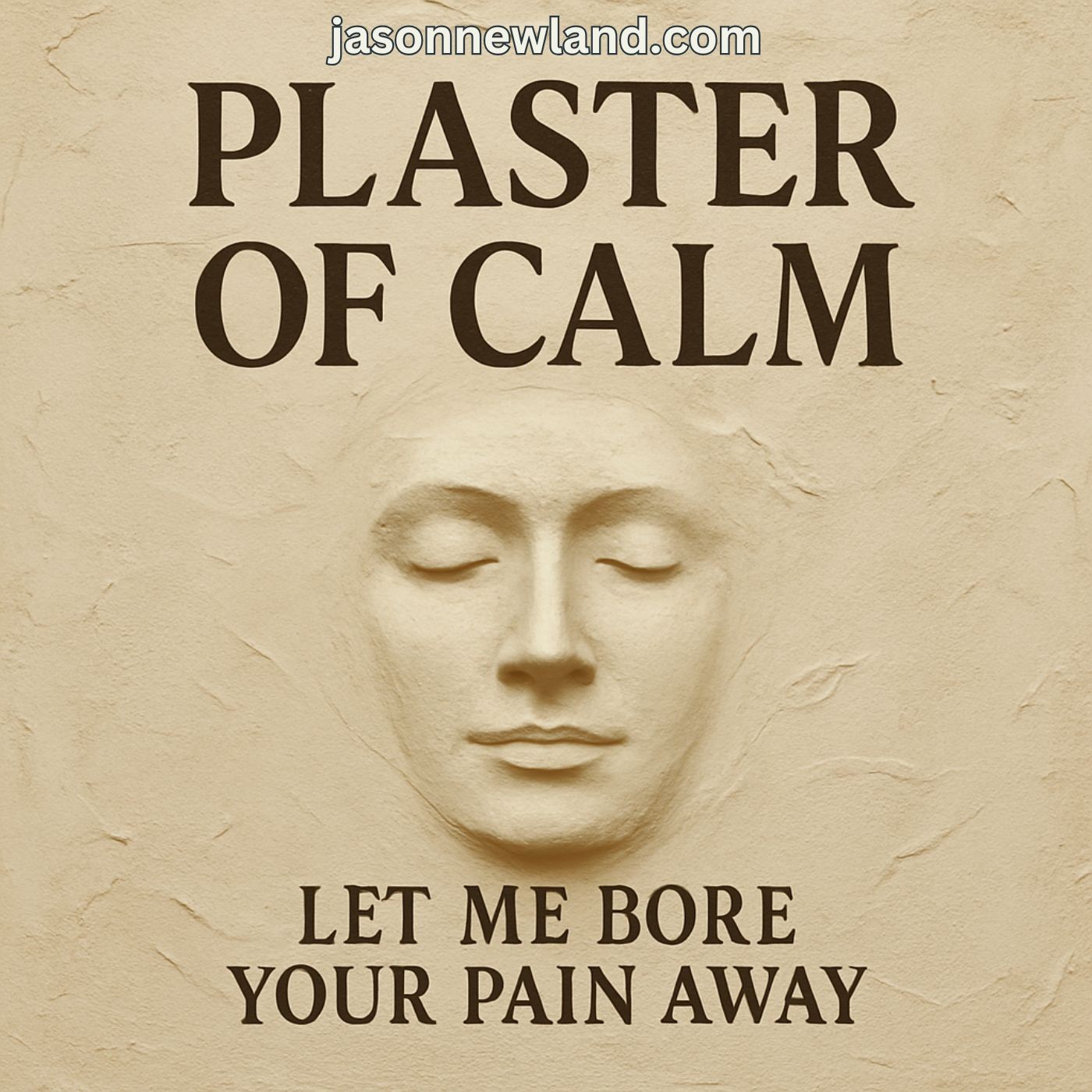
So things like, here's one, plaster of calm. Each breath adds another smooth layer. So you imagine every day that goes past another layer of kind of plaster, invisible plaster, or you could say a scab even, although it's just a weird word, covers that area, allowing you to breathe, allowing you to feel calm, and allowing you to feel more comfort.
And actually, I quite like the idea of this. It really comes from watching the Wizard of Oz. Do you know the Iron, is it the Iron Man? The Iron Man? The woodchopper? Is it Iron Man? Metal Man? Whatever.
He, you know, when he's stuck and they put the oil into his joints and he can move again. I quite like the idea. I do that with my lower back.
I just imagine that it's got some oil, some lubricant put in there. And it's just made it move a little bit more smoothly. And I do that on my right shoulder because I've got, you know, had an injury, a chronic issue with my right shoulder for about, blimey, 15 years.
No, what, nearly 20 years actually. And just imagine, you know, when it gets a little bit stiff, just imagine it being oiled, like melting butter, just like rubbed over the bones and in between the joints. And it feels nice, nice and warm and lubricated, like a liquid cushion.
There's lots of different things that you can remember. You can remember the physical feelings, lives, all physical feelings live in the nervous system, not in muscles or bones. So, when your nervous system or when your body moves towards safety, the muscles follow, the bones follow, wherever your mind goes, your body also follows.
So, when you focus on feeling relaxed, your body also becomes more relaxed. And it's just a standard remembrance. This is something I like to do.
It's more for, I guess, relaxation, but I like to just sit there and when there's nothing else going on, I can just focus on my breath. I don't try and control it. I just notice it.
And when I breathe in, I breathe in comfort. And when I breathe out, I exhale any tension or stress from my body or any other physical discomforts. And I breathe in comfort, maybe healing, whatever I want it.
It could be a colour, sometimes healing energy entering into my body. There's things like going to the toilet. Imagine tension, discomfort leaving my body when I go to the toilet.
Sometimes when I'm in bed, I imagine the bed sending healing energy into my body, into my back, my lower back, into my whole body. Just have this image in my head that it's a healing bed. So, when I lay down in it, my body almost automatically relaxes and that healing energy just moves through my body.
Sometimes if Vinny's next to me, when I'm on a settee, I put my hand on his back and I imagine that he's healing me, that he's sending relaxation to me. And sometimes I do it the other way. So, we're sending relaxation and healing to each other and connecting in that way.
So, it's about safety, I guess, feeling safe and realising that you are safe. And that is the end of this recording. So, thank you for listening.
Remember to be kind to yourself because you do deserve to be happy. And be gentle with yourself. You deserve to feel safe.
Lots of love. Bye.
Absätze sowie einige wiederkehrende Fehler bei Namen oder Titeln wurden korrigiert. Da der Text aus einer Sprachtranskription stammt, können einzelne Wörter oder Satzzeichen weiterhin fehlerhaft sein.